
How Acumen Handles a Child Who Is Struggling - Academically and Emotionally
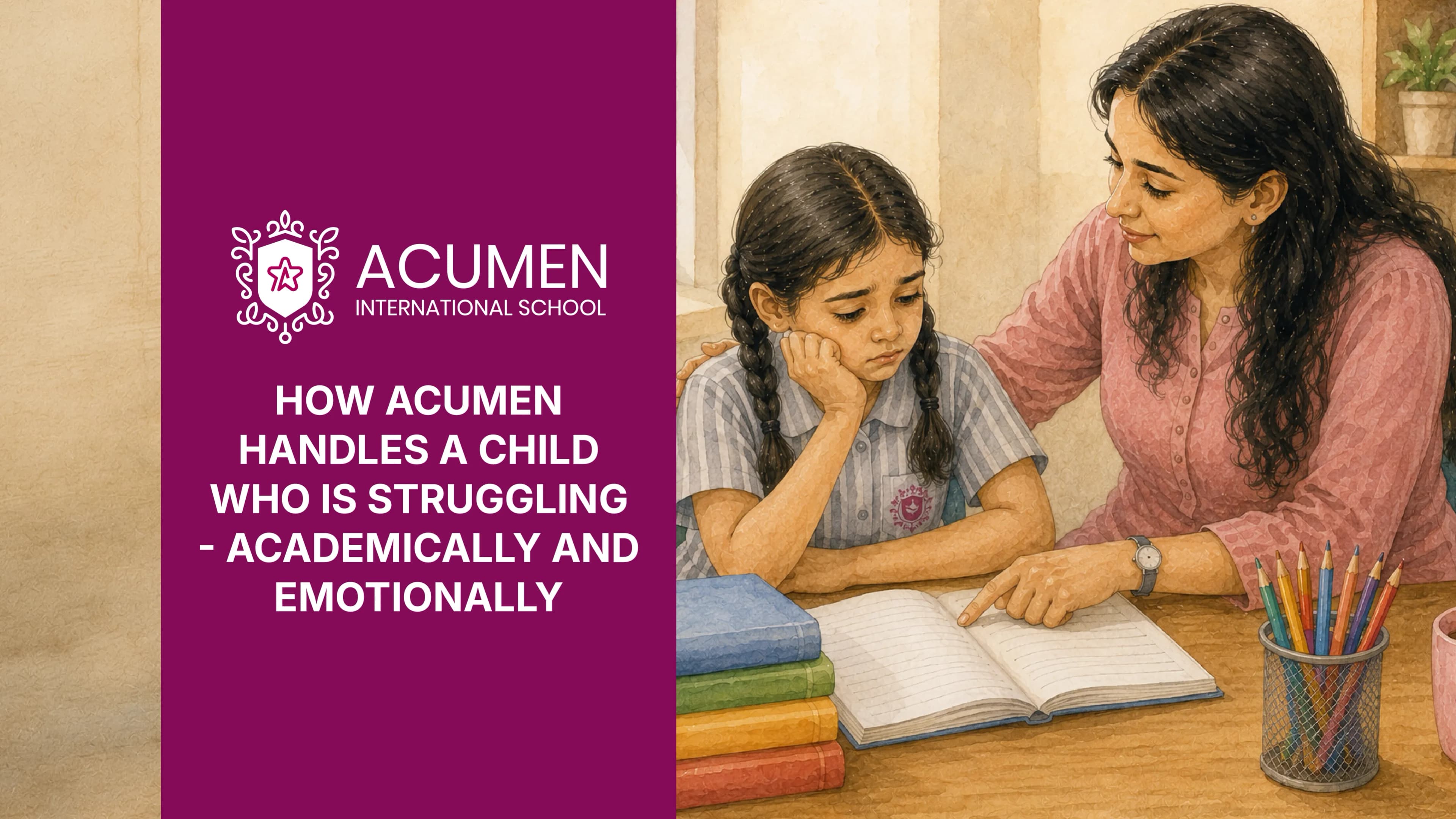
When a child starts struggling, it is rarely only about academics. Sometimes the first thing people notice is a drop in grades. A worksheet takes longer than usual. Reading becomes frustrating. Homework turns into a daily battle. But after spending time around children, it becomes clear that learning challenges often carry something else with them. Confidence becomes shaky. Participation drops. A child who once seemed eager suddenly becomes quieter.
At Acumen International School, we have always felt that looking only at marks misses an important part of the story. Children are not separated into academic and emotional parts. They bring all of themselves into the classroom every day. That is usually where support needs to begin.
Looking At The Child Before The Problem
It is easy to focus on what a child cannot do yet. The difficulty with that approach is that it often overlooks what the child is experiencing. At Acumen International School, we try to understand the reasons behind a struggle before rushing toward solutions. Sometimes a child needs more time. Sometimes they need concepts presented differently. Sometimes the challenge has very little to do with academics at all.
A difficult week, changing friendships, anxiety, or uncertainty can quietly affect learning in ways that are not always obvious. This is why our teachers, counsellors, and child psychologists work together to understand what may be happening beneath the surface. Good support often starts with careful observation rather than quick conclusions.
Learning Should Not Feel Like A Race
One thing that becomes obvious in any classroom is that children do not learn in identical ways. Some understand new ideas immediately. Others need repetition, discussion, movement, or hands-on experiences before concepts begin to click. At Acumen International School, we believe every child deserves personalised learning support that respects their pace of learning.
That does not mean lowering expectations. It means creating pathways that allow children to reach those expectations with confidence. Sometimes that looks like additional guidance from a teacher. Sometimes it comes through projects, creative activities, outdoor learning, or real-world experiences that make concepts easier to understand. When children stop feeling rushed, learning often becomes less intimidating.
Emotions Have A Bigger Role Than People Think
There is a tendency to treat emotional well-being as something separate from academics. In reality, they affect each other constantly. A child who feels worried or disconnected may find it difficult to focus. A child who repeatedly struggles in class may slowly begin doubting their own abilities. At Acumen International School, emotional wellbeing is woven into everyday school life rather than being treated as an occasional conversation.
Children express themselves through art, music, storytelling, movement, nature exploration, and collaborative activities. They are encouraged to ask questions, share ideas, and feel comfortable making mistakes. Over time, these experiences help create the kind of environment where children feel safe enough to keep trying. That sense of safety matters more than people sometimes realise.
Support That Feels Part of Everyday Learning
The most effective support often does not feel like support at all. It feels like a classroom where children are allowed to explore, participate, and learn in different ways. At Acumen International School, our approach combines hands-on learning, outdoor learning, creativity, and structured academics. This makes it easier to introduce academic intervention strategies naturally without making children feel singled out.
Some children benefit from extra practice. Others need different explanations. A few simply need renewed confidence before academic progress begins to appear again. Every child arrives with a different story, which is why support cannot look the same for everyone.
Growth Beyond The Classroom
A struggling child sometimes discovers confidence in unexpected places. Not during a maths lesson. Not during an assessment. But while speaking in front of classmates, performing on stage, planting something in a garden, building a project, or participating in a team activity. At Acumen International School, we place strong value on experiences beyond traditional academics because growth does not happen in only one direction.
Sports, performing arts, debate, public speaking, innovation activities, outdoor education, and creative exploration all create opportunities for children to discover strengths they may not have recognised before. Those moments matter because confidence developed in one area often begins showing up in others.
Sometimes Progress Is Hard To Notice
One thing that often gets overlooked is that progress does not always announce itself. It can be surprisingly quiet. A child who was afraid to answer questions raises a hand once. A child who avoided reading volunteers to read a paragraph. Small moments like these may not appear on a report card, but they often mean a great deal.
At Acumen International School, we pay attention to these changes because growth rarely happens all at once. Children usually move forward in small steps. When those steps are noticed and encouraged, they slowly begin to trust themselves again, and that trust matters.
The Acumen Approach To Helping Children Thrive
At Acumen International School, everything comes back to a simple belief. Children learn best when they feel understood. That belief shapes our classrooms, our wellbeing programmes, our teaching methods, and the relationships we build with students every day. Through child development support, experienced educators, counselling guidance, flexible teaching approaches, and a nurturing environment, we work to ensure that children never feel defined by a temporary struggle. Whether they are in the Early Years programme or progressing through primary school, we want every child to feel capable, valued, and supported as they grow.
When people think about struggling learners, the conversation often begins with academics. Yet over time, something else seems equally important. Children need to know that a difficult phase does not define who they are. At Acumen International School, we believe progress becomes possible when children feel safe, supported, and understood. Academic growth matters. Emotional wellbeing matters too. When both are given attention together, children often find their way forward with a little more confidence and a little less pressure. And perhaps that is what meaningful support was meant to look like all along.