
The Power of Curiosity: Why Asking Questions Matters In Class
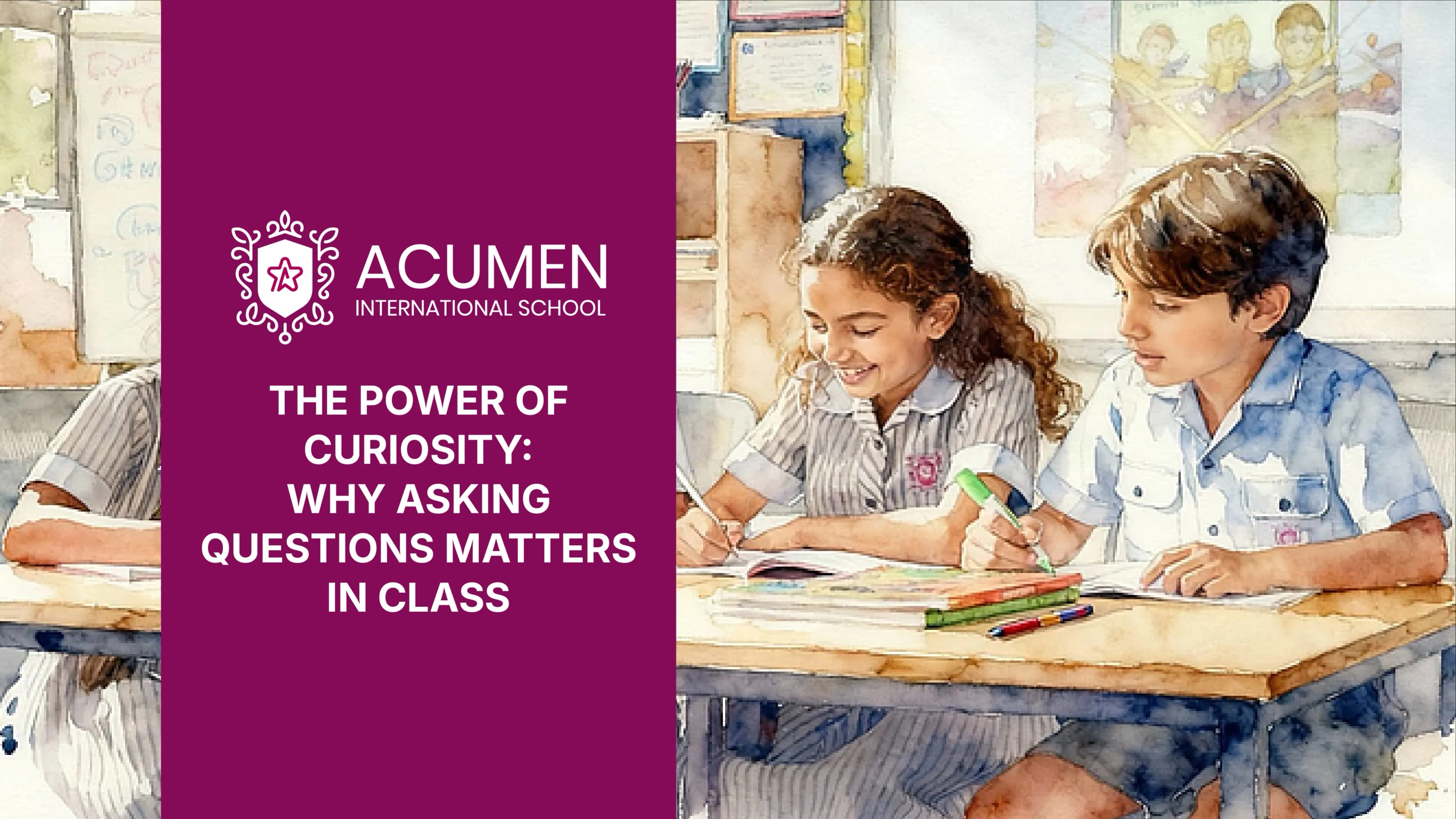
Some classrooms become quiet in a heavy way. The teacher speaks, students listen, notebooks fill, and the hour moves on. Other classrooms feel different. A hand goes up. Someone asks why something works that way. Another student adds a doubt that was sitting in the same place. The room wakes up a little. That small moment matters more than it first seems. Questions are not interruptions. They are often the sign that learning has started.
The importance of asking questions in class is not only about getting answers. It is about helping children notice that their thoughts matter. When a student asks something honestly, there is courage in it. There is attention in it too. It means the mind is awake and trying to connect ideas instead of simply storing them for later. At Acumen International School, we see that often. We believe children learn best when they feel safe enough to wonder out loud, test ideas, and sometimes ask questions that do not have neat answers.
Curiosity Is Often Quiet At First
Curiosity is not always loud or dramatic. Sometimes it looks like a child staring at a leaf for too long. Sometimes it sounds like, "What would happen if we changed this?" Sometimes it is just confusion that has not yet found the right words. Many children begin with natural curiosity, but some slowly learn to hide it. They worry about sounding wrong, slow, or different from others. That is why the environment matters so much. A classroom should not make questions feel risky.
The importance of curiosity in education becomes clearer when children are given room to think without fear. At Acumen International School, we build that room carefully. Our nurturing spaces, experienced educators, and child psychologists support confidence along with academics. We do not see confidence and curiosity as separate things. Usually, one grows beside the other.
This is one reason families looking for the best international school in Mokila, Kondakal, Hyderabad often connect with our approach. Children are not pushed into silence here. They are invited into learning.
Learning Feels Different When Children Participate
There is a clear difference between hearing a lesson and entering it. A child who asks why plants need sunlight may remember the answer. A child who then grows a plant, watches it bend toward light, and talks about it with classmates understands something deeper. The idea becomes real.
That is the heart of active learning in the classroom. Children learn through doing, discussing, observing, testing, and reflecting. At Acumen International School, this happens through project-based learning, outdoor exploration, experiments, collaborative tasks, and age-appropriate digital tools.
Our Early Learning program for Pre-Nursery, EY1, and EY2 blends play-based discovery with structured learning. Inspired by Reggio Emilia principles, children explore through hands-on experiences, nature spaces, phonics, vocabulary building, creative maths, music, movement, and mindful play. Curiosity is not treated like a side activity. We treat it as part of the main work of growing up. Sometimes adults think serious learning must look serious on the outside. But children often learn deeply while building, moving, asking, laughing, and trying again.
Questions Build Stronger Thinkers
Not every answer needs to come quickly. In fact, quick answers can sometimes close a door too soon. When students are encouraged to ask follow-up questions, compare ideas, and explain their thinking, they become stronger thinkers over time. They learn patience with uncertainty. They learn that not knowing something is not failure. It is the beginning of finding out.
In our Junior School, from Grade I to Grade V, we focus on strong foundations with joyful, real-world learning. Students develop communication, concept-based mathematics skills, science understanding, creative writing, sustainability awareness, coding, robotics, and design thinking. These are not just subjects to finish. They are ways to think.
The benefits of curiosity in learning often appear later. A curious child may become the student who solves problems calmly, works well with others, and keeps searching when something is difficult. Those habits are useful far beyond exams.
The Role Of Teachers Is Bigger Than Giving Answers
A thoughtful teacher does more than explain content. A thoughtful teacher notices hesitation, welcomes uncertainty, and knows when to ask a better question instead of giving a faster answer.
We value intentional and adaptive teaching at Acumen International School. Concepts are introduced clearly, but learning does not stop there. Teachers adjust to different learning styles and help each child move at a healthy pace. Some children need time. Some need challenges. Some need reassurance before they speak.
That balance matters. When children trust the adults in the room, they take intellectual risks. They try ideas. They speak. They wonder. Often, that is when real growth begins.
Curiosity Needs Space Beyond The Desk
Children do not only become curious while seated in rows. Sometimes curiosity grows in gardens, art rooms, sports grounds, and during field trips. Sometimes it grows while planting seeds in a kitchen garden and watching what daily care can do. Sometimes it grows during storytelling, debate, music, or teamwork in a club.
At Acumen International School, student life is designed to keep learning connected to real experience. Our clubs, sports, creative programs, and community events help children discover interests, friendships, resilience, and empathy. Well-being support also remains central, because children ask better questions when they feel safe, seen, and steady. That simple truth is often missed.
Why Acumen International School
At Acumen International School, this way of learning is not occasional; it shapes the entire day. From the moment children step into class, we create spaces where questions feel natural, not forced. Lessons are designed to invite thinking, whether through hands-on experiments, storytelling, or group discussions. Our teachers guide without rushing, allowing children to explore ideas at their own pace.
The blend of CBSE and international curriculum supports both structure and flexibility, so learning never feels limited. We see children slowly become more expressive, more confident, and more aware of how they learn, which quietly prepares them for much more than just academics ahead.
Final Words
A child who keeps asking questions is not being difficult. Often, that child is learning how to think. Classrooms should make room for wonder, doubt, mistakes, and discovery. That is where understanding becomes stronger, and confidence becomes genuine. The goal is not to produce children who repeat everything correctly. The goal is to help them become people who stay awake to the world.